Slate & Tile Roofing Cambridge & Cambridgeshire
Slate & Tile Roofing Across Cambridge & Cambridgeshire
Slate and tile roofing is by far the most common pitched roof covering across Cambridge and Cambridgeshire. The city’s Victorian and Edwardian housing stock — the terraces and semis across Romsey, Petersfield, Mill Road, Chesterton, Newnham and the older streets of central Cambridge — was built with natural Welsh slate, which when maintained correctly can last well over a century. The large post-war and 1960s-70s estates across the outer city and the Cambridgeshire towns are predominantly covered in concrete interlocking tile, which has a shorter working life of 40–60 years and whose mortar, nails and battens are now reaching the end of their serviceable life on the older stock. The historic market towns — Ely, St Ives, Huntingdon, St Neots — have their own mix of natural slate, plain clay tile and pantile on the older properties, with concrete tile on the post-war housing.
At Eagle Building & Roofing, we carry out slate and tile roofing work across all of Cambridge and Cambridgeshire. That includes single slate or tile replacement, re-slating or re-tiling individual slopes, full roof replacements, batten and underlay renewal, ridge and verge rebed, and matching materials to the correct specification for the age and style of the property. We always use the right material for the roof rather than the nearest available substitute, and we will tell you honestly whether a repair is the right answer or whether the roof has reached the point where a full replacement is more cost-effective in the long term.
Get a Free Slate or Tile Roofing Quote in Cambridge & Cambridgeshire
If you need help with your slate or tile roof, get in touch with Eagle Building & Roofing – we’ll be happy to assess the roof and talk you through the best options.
- 01223 258 150
- 07884 291 033
Get a Free Quote from Cambridge's Trusted Local Roofers
Slate Roofing Across Cambridge & Cambridgeshire
Natural Welsh slate is the predominant roofing material on Cambridge’s Victorian and Edwardian housing stock, and it remains the correct choice for repair and replacement work on these properties. The slates used on the terraces and semis built in Cambridge between approximately 1870 and 1914 are typically Cwm Machno or Penrhyn slate — medium-weight, blue-grey in colour, laid at a double-lap with copper or galvanised nails through pre-holed holes in a sand-and-lime mortar torching system on the older examples, or on sawn softwood battens on later ones. When repairs are needed, we source matched natural slate to the correct thickness and origin so replacements blend correctly with the existing roof rather than standing out as obviously new.
The most common failure mode on Cambridge’s older natural slate roofs is nail fatigue — the copper or galvanised fixing nails corrode over many decades until the slate is no longer held and slips on its neighbour below it. A roof with widespread nail fatigue is not a candidate for piecemeal repair; once a significant proportion of the nails have reached end of life, a full re-slating with new battens and underlay is the correct and most cost-effective long-term answer. We assess each roof honestly and will tell you which side of that line your roof is on.
For properties where natural slate is not required or not practical — new extensions, conversions, or budget-conscious re-roofs on non-historic properties — we also work with fibre-cement and synthetic slate products that offer a good visual match at lower cost and with a long manufacturer guarantee. We will recommend the right product for your property and budget and will not fit a synthetic slate on a property where natural slate is the correct specification.
Tiled Roofing Across Cambridge & Cambridgeshire
Tile roofing in Cambridge and Cambridgeshire divides broadly into three categories, each with different performance characteristics, repair requirements and aesthetics.
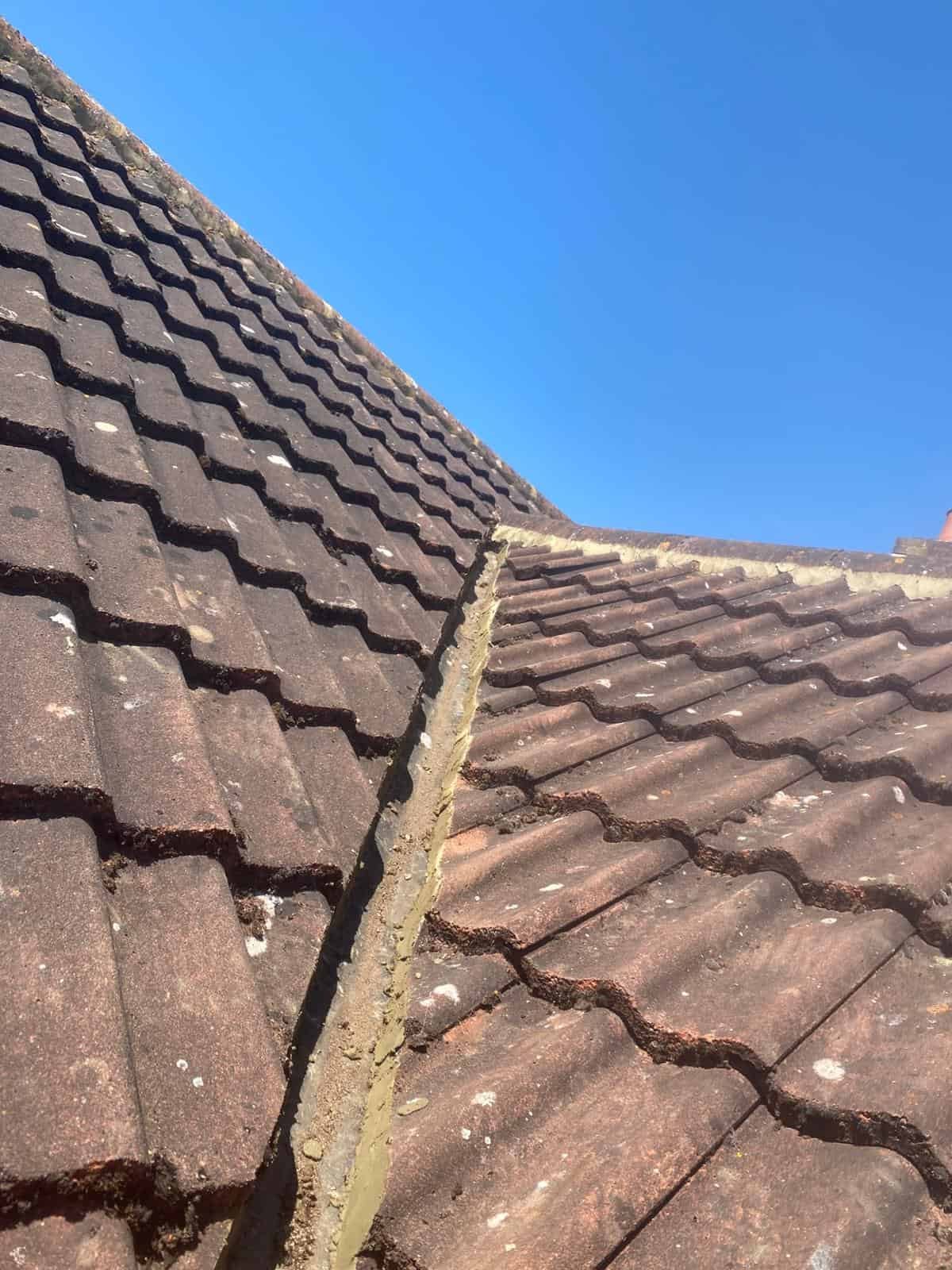
Concrete interlocking tiles are the most common roof covering across the city’s post-war and 1960s-70s housing stock — the large estates in Arbury, Kings Hedges, Orchard Park, Cherry Hinton and on the post-war housing in Huntingdon, St Neots and Peterborough. These tiles have a working life of 40–60 years, and roofs laid in the 1960s-80s are now approaching the end of their serviceable life. The primary failure indicators are perishing sand-and-cement mortar at ridges and verges, corroded or failed fixing nails causing tiles to rock, cracked tile faces due to freeze-thaw cycling, and deteriorating underlay. We carry out ridge and verge rebed, individual tile replacement, and full re-roofing in concrete interlocking tile when the roof has reached end of life.
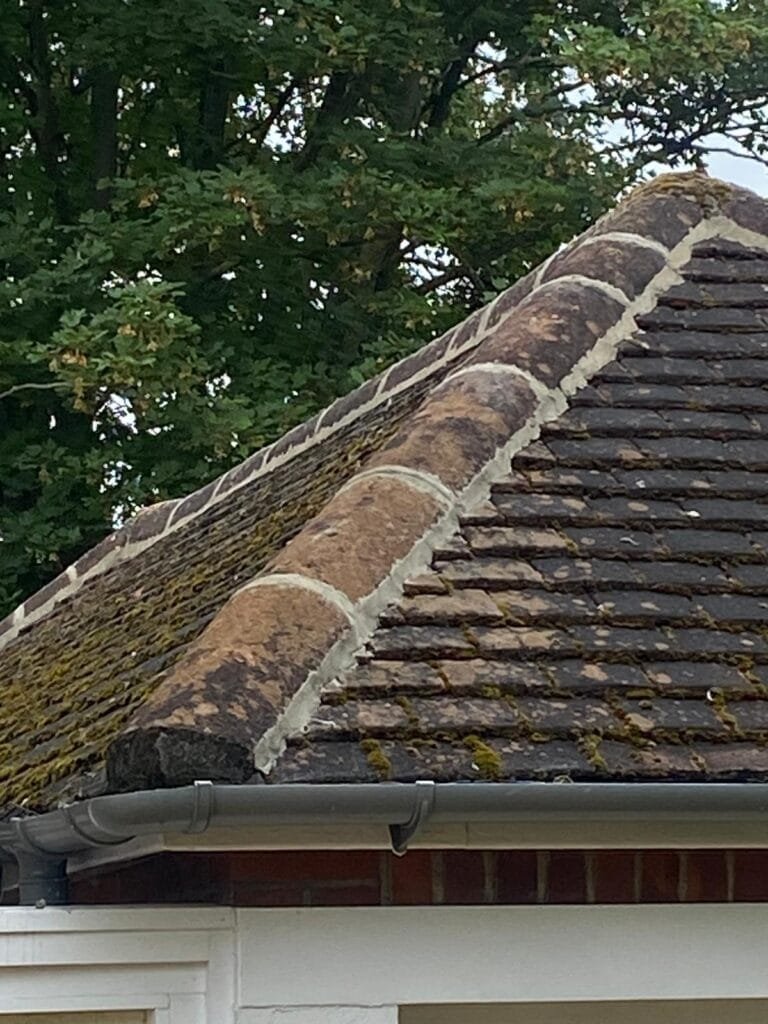
Clay plain tiles are found on the older properties in Cambridge’s historic streets and on period properties across the Cambridgeshire market towns and villages. Clay plain tiles are more expensive than concrete and require higher fixing density but offer an authentic appearance and a significantly longer serviceable life — 80–100 years or more on a well-maintained roof. When repairs are needed on clay plain tile roofs, we always source matched clay tiles to the correct profile and colour rather than substituting concrete, which would be immediately obvious and inappropriate on a period property or conservation area building.
Clay pantiles and plain tiles are also common in the Fens area of Cambridgeshire — Ely, March, Wisbech and the surrounding villages — reflecting the region’s Dutch and East Anglian building traditions. We carry out repairs and replacements on pantile roofs using correctly matched clay pantiles sourced to the appropriate profile and region. For all tile roofing work, we confirm the correct tile specification before ordering materials and provide a free written quote before any work begins.
Slate & Tile Roofing Across Cambridge & Cambridgeshire — Areas We Cover
We carry out slate and tile roofing work across Cambridge city and throughout Cambridgeshire — including Peterborough, Ely, Huntingdon, Wisbech, St Neots, St Ives, March and the surrounding towns and villages. Whether you need a slipped slate re-hung on a Victorian terrace in central Cambridge, a concrete tile ridge rebed on a Huntingdon semi, a clay tile repaired on a period property in Ely, or a full roof re-slating anywhere across the county, we cover the whole area. Call 01223 258 150 to confirm coverage and arrange a free inspection and quote.
Roofing Contractors Covering Cambridge & Cambridgeshire
- Arbury
- Newnham
- Girton
- Milton
- Chesterton
- Cherry Hinton
- March
- Histon
- Waterbeach
- Chatteris
- Sawston
- Trumpington
- Littleport
Get a Free Slate & Tile Roofing Quote in Cambridge & Cambridgeshire
If you need a reliable roofer in Cambridgeshire, we’re here to help. Whether it’s a small repair, a leaking roof or a full replacement, our team will get back to you quickly with honest advice and a fair, detailed quote. Just fill in the form and we’ll be in touch shortly – or if you’d prefer to speak to someone now, you can call us anytime.
Prefer to speak to us directly?
- Fully insured company
- Local tradesmen
- No pushy salesmen
- All quotes are free
- All work guaranteed
- Affordable prices

Testimonials
What Our Roofing Customers in Cambridge & Cambridgeshire Say
At Eagle Roofing & Building Ltd, customer satisfaction is our top priority. Don’t just take our word for it – read what our happy clients across Cambridgeshire have to say about our expert roofing services.
EXCELLENT Based on 11 reviews
 Posted on Google
 Akmal GopayraBest in Cambridgeshire with good rates and services ready for winter nowPosted on Google
 Char CleansI have used this company for various things now. Each time I am highly impressed with the work. I highly recommend this company if you need anything doing.Posted on Google
 Nevin JacksonI had eagle building and roofing fit new gutters to my property and they did a fanatic job really happy😊Posted on Google
 Jess HolmesI had all new gutters and new felt and battens applied very good communication would highly recommend could praise them high enough really reasonable pricePosted on Google
 Arthur RobinsonContacted Eagle Building And Roofing Ltd for a quotation on work to be carried out on my property including fitting insulation in my roof and new felt and Batons also which was done to a perfect standard really over the moon with the quote and the end result of the job could not recommend enough proper gentlemen.Posted on Google
 PaulI’ve had some work carried out bye Eagle building and roofing Ltd I had some facial boards and soffits plus new gutters all around my property and my chimney repointed very happy with the work and polite and trusting lads took up all rubbish and swept up after highly recommend will definitely be using them in the futurePosted on Google
 Peter BrownVery satisfied with there work as they fitted a new flat roof and done major repairs to my main tile roof also very professional and the work was done to a high standard highly recommend and will be using again in the futurePosted on Google
 JohnEagle building and roofing are a great company very professional at what they do they put a new slate roof on the front and back of my property and I couldn’t be happier highly recommendVerified by TrustindexTrustindex verified badge is the Universal Symbol of Trust. Only the greatest companies can get the verified badge who has a review score above 4.5, based on customer reviews over the past 12 months. Read more
Frequently Asked Questions — Slate & Tile Roofing in Cambridge
Here are some of the questions we’re often asked by homeowners across Cambridge – hopefully they help, but if not, just get in touch and we’ll be happy to assist.
Visible signs to look for include slipped or cracked slates or tiles visible from the ground, broken pieces of slate, tile or mortar in the garden or gutters after windy weather, rocking or misaligned ridge tiles, damp patches or tide marks on ceilings or walls that appear or worsen after rain, or daylight visible from inside the loft. On Cambridge's Victorian properties in particular, also check the chimney stack from the ground after any significant storm — cracked stacks and displaced chimney flashings are a common source of water ingress on older terraced and semi-detached properties. If you spot any of these signs, we offer free inspections and will give you an honest assessment of the condition of the roof and what, if anything, needs doing.
Yes — matching the existing material is a core part of every repair we carry out. For natural slate roofs on Cambridge's Victorian and Edwardian properties, we source replacement slates to the correct thickness, origin and colour — Welsh blue-grey slate for the majority of Cambridge's period housing. Using a non-matched synthetic or imported slate on these roofs creates an immediately obvious visual mismatch that can also affect the property's value and its status in a conservation area. For concrete tile roofs, we match the profile, colour and manufacturer wherever possible. For clay plain tile and pantile roofs, we source appropriate second-hand or new-old-stock tiles to match the existing profile and colour. We confirm the correct specification before ordering and will tell you if a suitable match is not readily available.
Lifespan varies significantly by material and maintenance. Natural Welsh slate, when properly installed and maintained, will typically last 80–100 years and often significantly longer — many Cambridge Victorian terraces still have their original slates in serviceable condition. Concrete interlocking tiles have a working life of 40–60 years; roofs laid in the 1960s and 70s in Cambridge and across the Cambridgeshire towns are now approaching or past that point. Clay plain tiles and pantiles, when properly maintained, can last 80–100 years and more, though the mortar, battens and underlay beneath them will need renewal before the tiles themselves reach end of life. The limiting factors on most roofs are not the tile or slate itself but the fixings (nails, battens) and the underlay — we assess the full roof system, not just the visible covering, and will give you a clear picture of how much useful life remains.
On natural slate roofs, the most common cause is nail fatigue — the fixing nails corrode over many decades and eventually fail, leaving the slate resting on its lower neighbour rather than being mechanically fixed. A single slipped slate can usually be re-hung, but if a significant number of slates are slipping it typically indicates that the nails across the roof are all at a similar stage of deterioration, and a full re-slating is the right answer rather than continuing to re-hang individual slates indefinitely. On concrete tile roofs, slipping is usually caused by a failed or missing tile peg, a broken tile tail, or degraded batten fixing. On mortar-bedded ridge tiles, mortar shrinkage and frost cycling cause the mortar bond to fail, leaving ridge tiles rocking loose. We diagnose the cause accurately before recommending a repair or re-roof.
Yes — storm damage repairs are a regular part of our work across Cambridge and Cambridgeshire. The Fens' exposure to south-westerly and northerly winds during autumn and winter storm events means that ridge tiles on roofs with perished mortar, loose verge mortar on concrete tile roofs, and slates on roofs with corroded nails are all at elevated risk during high winds. When storm damage occurs, we respond as quickly as possible, make the roof safe and watertight as the immediate priority, and then carry out the permanent repair once conditions allow. We can provide a written report of damage and repairs carried out for insurance claim purposes if required.
Yes — and a significant proportion of our slate and tile roofing work in Cambridge is on older and period properties. Cambridge has extensive conservation areas across the central city and the historic residential streets, and many individual listed buildings throughout the county. On these properties, repair and replacement work must use like-for-like materials — natural slate rather than synthetic, clay tile rather than concrete, lime mortar rather than cement in appropriate situations. We advise on the correct specification for conservation area and listed properties as part of our free inspection visit, and carry out all work to the standard required to maintain the character and integrity of the building. If you are unsure whether your property has any designation, we can advise.
Yes, provided the repair correctly addresses the source of the water entry. A single slipped slate properly re-hung, or a tile replaced and the surrounding mortar checked, will prevent water entry through that point. However, it is important to understand that a damp patch on a ceiling does not always indicate a single point of failure — water can travel along rafters or battens before dripping through, so the entry point may be some distance from where the water appears inside. We trace the source rather than just replacing the nearest damaged slate or tile, and check the surrounding area for secondary failure points while we are on the roof. All repairs carry a workmanship guarantee.
Yes — all quotes are free with no obligation. As a general cost guide: replacing individual slipped slates or cracked tiles typically starts from £100–£200; ridge tile rebed on a standard semi-detached property from around £300–£600; re-slating or re-tiling an individual roof slope from approximately £800–£2,500+ depending on size and material; a full natural slate re-roof on a typical Cambridge Victorian terrace from around £4,000–£10,000+ depending on roof area and specification. All prices are confirmed in a fixed written quote after inspection — call 01223 258 150 or use the contact form to arrange a free visit.
For Victorian and Edwardian properties in Cambridge, particularly those in conservation areas or with a listed building designation, natural Welsh slate is the correct specification and may be a requirement under planning conditions. Natural slate matches the original material, has an indefinite lifespan when properly maintained, and preserves the character and value of the property. Synthetic or fibre-cement slate products offer a good visual match at lower initial cost and suit new extensions, loft conversions and re-roofs on non-historic properties where natural slate is not a requirement. We advise on the right choice for your specific property and will always confirm whether conservation area or listed building considerations apply before specifying materials.
Next Page: Facias, Soffits & Guttering – Cambridge